Can You Monetize Twitch Clips on YouTube? What the Rules Say in 2026
 Founder, klypra – @henri_tmp
We went through YouTube's own monetization rules to answer the question every clip channel runs into: can reposted Twitch moments earn money there, and if not, what does?
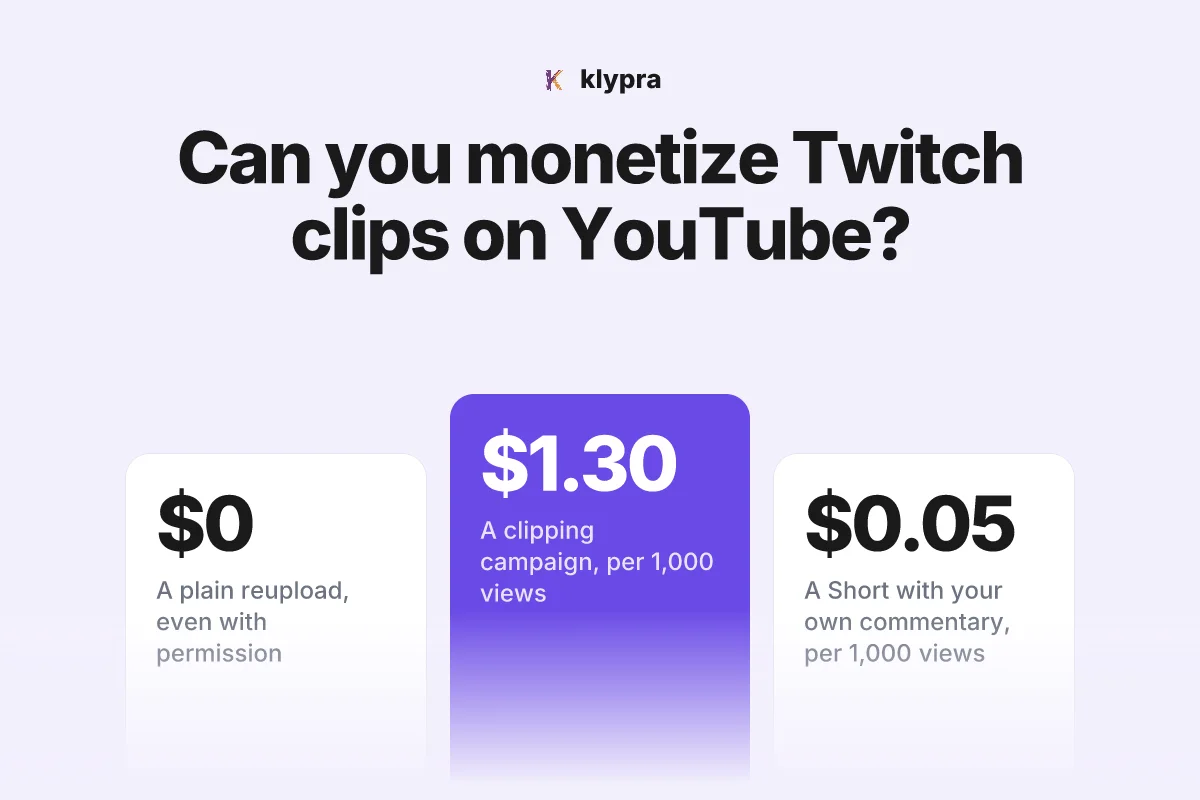
Three ways to post a Twitch clip on YouTube, and which of them can earn.
Can you make money from Twitch clips on YouTube?
Only if you add something of your own. A Twitch clip reposted as it is, or stitched into a compilation with nothing added, falls under YouTube's reused content policy and cannot earn ad revenue. A clip you turn into something new, with your own voice commentary, a critique or a storyline, can be monetized once the channel is in the YouTube Partner Program.
That rule is the reason most clip channels on YouTube earn nothing from YouTube itself. It is also why the money in clipping comes mostly from somewhere else, which we get to below.
What does YouTube's reused content policy allow?
Reused footage is fine when a viewer can tell there is a meaningful difference between the original and your video. YouTube's own examples draw the line clearly.
| What you post | Can it be monetized? | Why |
|---|---|---|
| A Twitch clip reposted as it is | No | No meaningful difference from the original |
| A compilation of clips with no narrative | No | YouTube names little-or-no-narrative compilations as not allowed |
| A clip with captions and a crop only | No, in most cases | Formatting alone rarely makes a meaningful difference |
| A clip with your own voice commentary | Yes | Commentary on the original is one of YouTube's allowed examples |
| Edited clips with a storyline you added | Yes | Added storyline and commentary is an allowed example |
| A critical review using clips | Yes | Clips used for critique are an allowed example |
| The streamer's own clip channel | Yes | It is the streamer's own content |
Two details matter more than they look. The policy applies to the channel as a whole, so a channel that is mostly plain reuploads is judged on that, even if a few videos have commentary. And since July 2025 YouTube also names mass-produced, templated videos under its inauthentic content policy, which catches the clip-plus-generic-caption format many automated channels use.
Does the streamer's permission change anything?
Not for monetization. YouTube says the reused content policy applies even when the original creator has given permission, and lists promoting other people's content as not allowed even with permission. Permission protects you from the streamer filing a copyright claim; it does not make a plain reupload eligible for ads.
The one setup where clips can earn as they are is the streamer's own channel. Many larger streamers run a clip channel on their own account, often edited by someone else. That footage is theirs, so the reused content rule does not apply to it.
What does a channel need to join the YouTube Partner Program?
1,000 subscribers plus one of two activity paths, and the bar rises in February 2027. Without the Partner Program, no video on the channel earns ad revenue, however transformed it is.
| Requirement | Until January 31, 2027 | From February 1, 2027 |
|---|---|---|
| Subscribers | 1,000 | 1,000 |
| Long-form path | 4,000 watch hours in 12 months | 8,000 watch hours in 12 months, for new channels |
| Shorts path | 10 million Shorts views in 90 days | 20 million Shorts views in 90 days, for new channels |
| Earning from Shorts each month | No extra condition | 10 million qualified Shorts views in the past 90 days |
Watch hours from Shorts do not count towards the long-form path. For a clip channel built on Shorts, the 2027 rule is the one to plan around: a channel that drops below 10 million Shorts views in a 90-day window earns nothing from Shorts that month.
How much do Twitch clips earn on YouTube Shorts?
About $0.03 to $0.07 per 1,000 views for an eligible channel, so roughly $30 to $70 per million. Shorts are not paid per ad. The ad revenue from the Shorts feed is pooled each month, split by each channel's share of engaged views, and the creator keeps 45 percent of their part.
Two rules shrink that further for clip channels. Unedited clips, reuploads and compilations without added original content do not count as eligible views at all. And music costs: a Short with one licensed track sends half of its revenue to music partners, two tracks two thirds. Our earnings calculator puts those rates next to TikTok and clipping campaigns for any number of views.
What happens with copyright claims on Twitch clips?
A Content ID match lets the rights holder block the video, run ads on it and take the revenue, or just track it. On Twitch clips the usual trigger is music: a song playing in the background of the stream, or an in-game radio station like the ones in GTA.
On Shorts it is stricter. A Short longer than one minute that contains claimed content is blocked and cannot earn at all. If a clip has music in it, keeping it under a minute, or cutting the music, is the difference between a Short that runs and one that does not.
How do you make Twitch clips that can be monetized?
Add the part YouTube is looking for: you. In practice that means one of these.
- Voice commentary. Record your take over the clip: what happened, why it matters, what the chat missed.
- A storyline. Several clips around one arc, a feud, a run, a launch night, with your narration tying them together.
- Critique or analysis. Break down a play, a decision or a reaction, using the clip as evidence.
- Work for the streamer. Edit for their own clip channel, where the footage is theirs to monetize.
All four take more time per video than a straight repost, which is exactly why they qualify. The raw material still has to come from somewhere: klypra finds the moments chat reacts to while the stream is live, so the time goes into the commentary rather than into scrubbing VODs.
What pays for Twitch clips if YouTube does not?
Clipping campaigns. The streamer or a brand sets a budget and pays per 1,000 views on clips you post, on YouTube, TikTok or Instagram, whether or not your channel is monetized. Whop campaigns paid a median of about $1.30 per 1,000 views in October 2026, twenty times or more what an eligible Short earns from YouTube.
Campaigns have their own rules, view checks and budgets that run out, and they are compared in which platform pays the most for clipping. For a full plan from zero, see how to make $1,000 a month clipping.
Frequently asked questions
Can you monetize Twitch clips on YouTube?
Not as plain reuploads. YouTube’s reused content policy excludes channels that post other people’s footage without a meaningful difference, such as their own commentary or a storyline. Clips you transform with commentary, critique or narrative can be monetized once the channel is in the YouTube Partner Program.
Does the streamer’s permission let me monetize their clips?
No. YouTube states that its reused content policy applies even if you have the original creator’s permission. Permission protects you from a copyright claim by the streamer, but it does not make an unedited reupload eligible for ads. The exception is the streamer’s own channel, because it is their content.
How much do Twitch clips earn on YouTube Shorts?
For an eligible channel, about $0.03 to $0.07 per 1,000 views. Shorts are paid from a shared pool, and the creator keeps 45 percent of their share. Unedited reuploads of other people’s content do not count as eligible views at all.
What does a YouTube channel need to be monetized?
1,000 subscribers plus either 4,000 watch hours in the last 12 months or 10 million Shorts views in the last 90 days. From February 1, 2027, new channels need 20 million Shorts views or 8,000 watch hours, and Shorts earnings in a given month need 10 million Shorts views over the previous 90 days.
Is there a way to earn from Twitch clips without YouTube monetization?
Yes, clipping campaigns. The streamer or a brand pays per 1,000 views on clips you post, whether or not your channel is monetized. Whop campaigns paid a median of about $1.30 per 1,000 views in October 2026.
How we checked this
Every rule in this article comes from YouTube's own help pages, read on November 5, 2026: channel monetization policies (reused and inauthentic content), Partner Program eligibility, Shorts revenue sharing and Content ID claims. The February 2027 thresholds were announced by YouTube in August 2026. The Shorts rate is the range creators report; YouTube publishes no fixed rate.